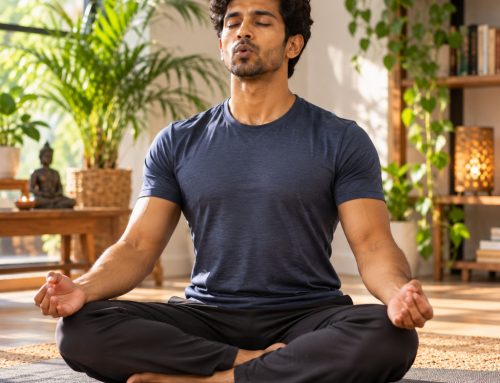

When we think about improving our well-being, we often divide the solution into two separate categories. For the body, we exercise: walk, run, lift weights, stretch or do mobility work. For the mind, we meditate, practice mindfulness, work with our breathing or use techniques designed to help us slow down and reconnect with ourselves.
Both approaches can be valuable on their own. But a growing body of research points toward a simple and potentially powerful idea: We may get more from our well-being practice when we train the body and mind together. The point isn’t to do more. It’s to create a more complete approach to well-being.
Your Body and Mind Aren’t Separate Systems
Modern life makes it easy to treat physical and mental health as different projects.
Feeling physically unfit? Exercise.
Feeling stressed? Meditate.
Feeling restless? Go for a run.
Feeling overwhelmed? Try breathing exercises.
But our actual experience isn’t divided so neatly. Stress can show up physically as tension, restlessness or disrupted sleep. Movement can change how we feel emotionally. Our breathing changes when we’re anxious, relaxed or physically active. And our mental state can influence whether we feel motivated to exercise in the first place.
In other words, our physical and psychological well-being constantly interact. So it makes sense to work with both.
What Physical Exercise Does for the Mind
The benefits of physical activity extend well beyond stronger muscles and cardiovascular fitness.
The World Health Organization reports that regular physical activity is associated with better mental health, cognitive health and sleep, as well as reduced symptoms of anxiety and depression. It also contributes to the prevention of cardiovascular disease, type 2 diabetes and other chronic conditions.
And “exercise” doesn’t have to mean intense workouts. Walking counts. Cycling counts. Dancing counts. Strength training counts. Taking the stairs counts. Going for a gentle jog counts. Movement is one of the tools available to us for supporting both physical and psychological well-being.
Even individual sessions can matter. The CDC notes that a single bout of moderate-to-vigorous physical activity can provide immediate benefits including reduced feelings of anxiety and improved sleep, while consistent activity provides a much wider range of long-term health benefits.
Move the body, and the mind often benefits too. But there’s another side to the equation.
What Mental Practices Bring to the Body
Meditation, mindfulness and breathwork approach well-being from a different direction. Instead of starting with movement, they start with attention.
You notice your breath.
You become aware of sensations in your body.
You observe thoughts rather than automatically following every one of them.
You practice returning your attention to what’s happening right now.
Breathwork has also attracted growing scientific interest. A 2023 meta-analysis of randomized controlled trials found that breathwork interventions were associated with lower self-reported stress compared with control conditions, with additional improvements in anxiety and depressive symptoms.
Mental practices aren’t about becoming permanently calm or eliminating difficult thoughts. Think of them more as training attention, awareness and our response to experience. And this is where things get particularly interesting.
What Happens When We Combine the Two?
Instead of asking: “Should I exercise or meditate?” A better question might be: “What happens if I do both?” A 2024 systematic review published in Mental Health and Physical Activity examined 35 trials involving interventions that combined physical activity and mindfulness.
The researchers concluded that combined approaches show promise for improving mental health and well-being. Across comparisons with passive control groups, combined interventions frequently produced improvements in psychological health.
Physical activity and mindfulness each have established benefits, and combining them appears feasible, beneficial and potentially more effective for some outcomes and people. Larger studies are now needed to understand exactly when and how the combination provides additional benefits.
That’s a compelling reason to stop thinking of mental and physical well-being as competing choices.
One Study Offers a Fascinating Example
Researchers at Rutgers University developed an intervention called Mental and Physical (MAP) Training, combining focused-attention meditation with aerobic exercise. Participants completed 30 minutes of meditation followed by 30 minutes of moderate-intensity aerobic exercise, twice a week for eight weeks.
Among participants with major depressive disorder, depressive symptoms and ruminative thoughts decreased significantly following the program. The study also reported improvements among participants without depression.
It illustrates an important principle:
We don’t necessarily have to choose between working through the body and working through the mind. We can do both.
In the second part of the article you’ll read about how to bring it all together in practice.